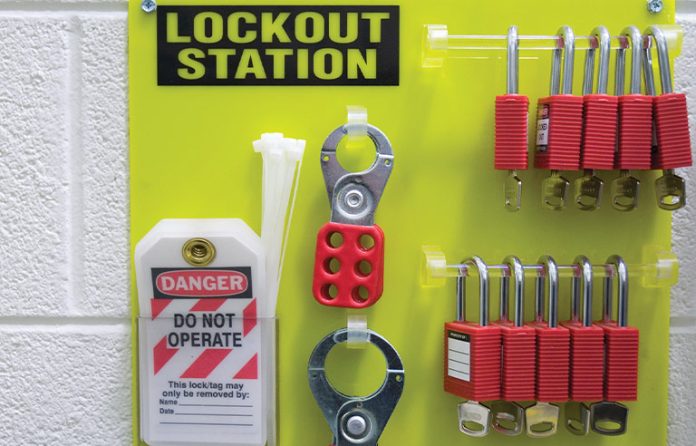
Photo: Westhoff/gettyimages
Workers who service or maintain machines and equipment “may be exposed to serious physical harm or death if hazardous energy is not properly controlled,” OSHA cautions.
The agency’s standard on lockout/tagout (1910.147) explains that employers are responsible for protecting workers from hazardous energy sources on machines and equipment during such activities.
Employers should implement an energy control program specific to their workplace and then train workers on hazardous energy control procedures. OSHA requires that the training cover at least three areas:
- Aspects of the employer’s energy control program
- Elements of the energy control procedure relevant to the employee’s duties or assignment
- The various requirements of the OSHA standard on lockout/tagout
Some of the “most critical requirements” are:
- Use lockout devices for equipment. “Tagout devices may be used in place of lockout devices,” OSHA says, “only if the tagout program provides worker protection equivalent to that provided through a lockout program.”
- Ensure all new or updated equipment can be locked out.
- Develop a tagout process to be followed for machines or equipment that can’t be locked out.
- Enforce energy control procedures.
- Use only “durable, standardized and substantial” lockout/tagout devices authorized for the specific equipment or machine.
- Make sure the lockout/tagout devices identify individual user(s).
- Create a policy that “permits only the worker who applied a lockout/tagout device to remove it.”
McCraren Compliance offers comprehensive safety training to help prevent accidents. Visit our class calendar to see how our training and consulting services can enhance your safety efforts.
Original article published by Safety+Health an NSC publication