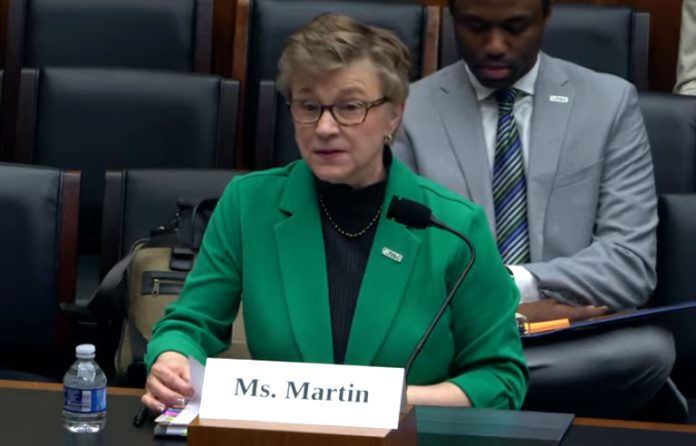
National Safety Council CEO Lorraine M. Martin testified May 13 during a House Workforce Protections Subcommittee hearing. Photo: House Committee on Education & Workforce
Washington — Proposed White House budget cuts risk transforming OSHA into an “injury investigation agency instead of an agency that’s out there trying to proactively prevent injuries,” a former head of OSHA says.
Doug Parker, now a health and safety policy consultant, was among a panel that testified during a May 13 House Workforce Protections Subcommittee hearing titled, Building a Safer Future: Private-Sector Strategies for Emerging Safety Issues.
In his written testimony, Parker cited the Department of Labor’s budget in brief, released April 3, that proposes a nearly 7.5% budget cut for OSHA for fiscal year 2027 (which begins Oct. 1). This includes a 13.5% reduction for agency enforcement and a 36% cut in health and safety inspections from 2025 levels.
Federal OSHA already is operating with “well below” 700 compliance safety and health officers, Parker said, the lowest total in its history. In his view, additional cuts will mean further “degrading” of the worker safety landscape.
“If OSHA can’t respond to as many worker complaints as it used to because it has to triage its staff with limited resources, then those hazards that workers are complaining about go unaddressed,” Parker said in response to questioning from Rep. Ilhan Omar (D-MN), the subcommittee’s ranking member.
“OSHA ends up focusing its resources on and doing inspections that are going to get the most attention, like fatalities, which appropriately should be enforced. But it limits them in doing the kinds of things that we’re here to talk about, which is proactive measures that can reduce injuries in the workplace by addressing hazards before they hurt someone.”
In her testimony, National Safety Council CEO Lorraine M. Martin highlighted multiple focus areas NSC believes would enhance the future world of work. Among them: calling on OSHA to develop a National Emphasis Program on serious incident and fatality prevention (commonly called SIFs) that emphasizes identifying hazards and establishing controls to prevent incidents before they occur.
She also advocated for increased employer attention on worker well-being through initiatives that prioritize awareness of employee mental health, fatigue, stress and impairment.
Martin testified that although artificial intelligence and other emerging technologies have had a positive impact on identifying risks and recommending hazard controls, it’s vital that organizations also remain reliant on human judgment.
“Any time we adopt a new technology, there’s often a challenge of making sure it’s accepted, that the employees understand how it’s helping them, how it’s making their job safer,” Martin said in response to a question from Rep. Tim Walberg (R-MI), chair of the House Education and Workforce Committee. “And so having employees at every step of that process is one of the most important things to do to ensure that you can get through some of those barriers.”
Multiple panelists suggested that modernizing OSHA’s standard on lockout/tagout (1910.147) would help put fewer workers at risk.
In her testimony, employment attorney Melissa Peters wrote that the standard is “frozen in 1989 technology” – referring to the year in which the standard was promulgated. She and other worker safety experts contend that OSHA can improve workplace safety by allowing the use of computer-based systems that provide worker protection. In September at the 2025 NSC Safety Congress & Expo in Denver, Andrew Levinson, director of OSHA’s Directorate of Standards and Guidance, said the agency is expected to “move aggressively” on its lockout/tagout update. The revision likely will include computer-based controls for hazardous energy.
During the May 13 hearing, Parker, Levinson’s former colleague at OSHA, also expressed concern over the Trump administration’s efforts related to NIOSH, including moving to consolidate the safety research agency or cutting hundreds of employees.
“NIOSH research is really world class,” he said in response to questioning from Rep. Haley Stevens (D-MI).
Omar agreed.
“While those cuts have been reversed, there’s still significant concern that NIOSH has lost many valuable experts to attrition, and we don’t know whether the agency is being allowed to replace them,” Omar said in her opening statement.
“OSHA and NIOSH are our best, longstanding tools to stop workplace harm. It’s vital that we fully fund and staff these agencies to identify and correct unsafe working conditions, because voluntary compliance programs or leading indicators alone will not be enough.”
Rep. Ryan Mackenzie (R-PA), who chairs the subcommittee, stressed the importance of collaborating to create policy that extends beyond compliance.
“As we look ahead, one thing is clear: Effective workplace safety policy can’t be developed in isolation,” Mackenzie said at the start of the hearing. “Policymakers, workers, employers, safety professionals and industry experts must all have a seat at the table. To truly improve safety outcomes, regulations must include meaningful input from the workers, employers and safety professionals responsible for implementing them every day. Lasting workplace safety improvements require policies that both protect workers and remain practical, adaptable and responsive to evolving risks.”
McCraren Compliance offers comprehensive safety training to help prevent accidents. Visit our class calendar to see how our training and consulting services can enhance your safety efforts.
Original article published by Safety+Health an NSC publication