What features matter most in an eye/facewash when workers handle corrosives or irritants?
Responding is Ryan Pfund, senior product manager, Bradley, Menomonee Falls, WI.
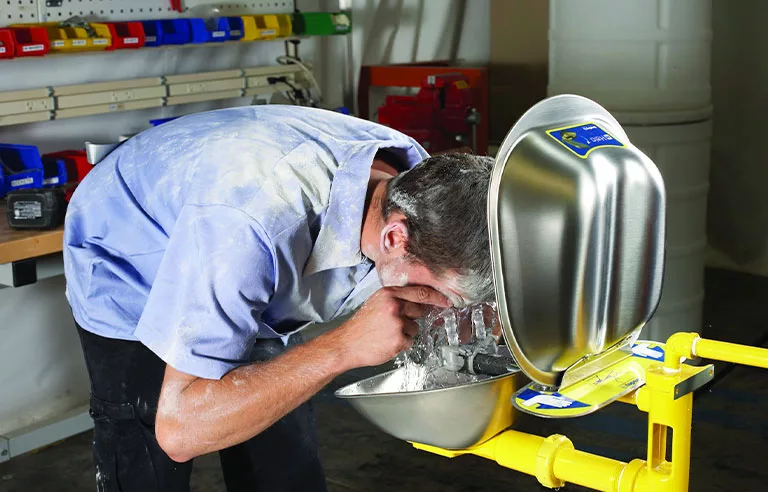
When employees work with corrosive chemicals, acids, alkalis or strong irritants, emergency eyewash fixtures become a critical last line of defense. In those first few seconds after exposure, workers rely on eyewash units that deliver fast, complete and comfortable flushing. The right features not only improve compliance with the ANSI/ISEA Z358.1-2014 standard, but also help minimize eye or facial injury by encouraging a full, uninterrupted 15-minute rinse with tepid water (60°-100° F).
Here are the features that matter most.
1. Full, uniform washdown coverage
Chemical splashes often affect more than just the eyes. Fallout from vapors, mists and splashes can reach the forehead, cheeks and surrounding facial areas. That’s why eye/facewash units – not just basic eyewash bowls – are recommended in many chemical-handling environments.
Modern eyewash designs use a carefully engineered water pattern that provides 360-degree coverage across the eyes and face. Instead of two narrow streams, the water flows in a gentle, high-volume deluge that encourages the worker to keep their eyes open, increasing the effectiveness of the flush. This uniform flow is essential for washing away contaminants quickly and thoroughly.
2. Ergonomic, contoured bowl design
Emergency situations are chaotic. Workers may reach the fixture while distressed or unable to see or fully orient themselves. A well-designed bowl helps guide the face into the optimal position automatically.
Contoured, deep-dish bowls – especially those with radiused edges – keep water flowing directly toward the drain, helping to prevent chemical-laden rinse water from pooling or splashing. They also help position the user’s face in the correct spot without requiring precise alignment, improving the odds of an effective flush in the moments when it matters most.
3. Protective dust covers and durable materials
If left uncovered, eyewash units can accumulate dust, debris, overspray and facility contaminants – especially in industrial, chemical or maintenance environments. When the fixture activates, contaminants inside the spray heads could wash directly into the eyes.
That’s why integrated dust covers are so important. They protect spray outlets between activations and automatically flip open automatically when the unit is triggered. For even greater protection, a full bowl cover will not only protect the spray head, but it will also keep the entire bowl clean. Some products will include a clear bowl cover for quick inspection and no surprises when the bowl cover is lifted.
Also, chemical splash zones can be harsh on equipment. Stainless steel components and corrosion-resistant coatings support long-term performance, especially around acids, solvents and caustic cleaners.
A safer response when seconds matter
Chemical exposure scenarios are unpredictable, but the performance of your emergency equipment shouldn’t be. By prioritizing full washdown coverage, ergonomic bowl design, protective dust covers and corrosion-resistant materials, employers can help reduce the severity of eye injuries and strengthen their chemical safety programs.
McCraren Compliance offers many opportunities in safety training to help circumvent accidents. Please take a moment to visit our calendar of classes to see what we can do to help your safety measures from training to consulting.
Original article published by Safety+Health an NSC publication