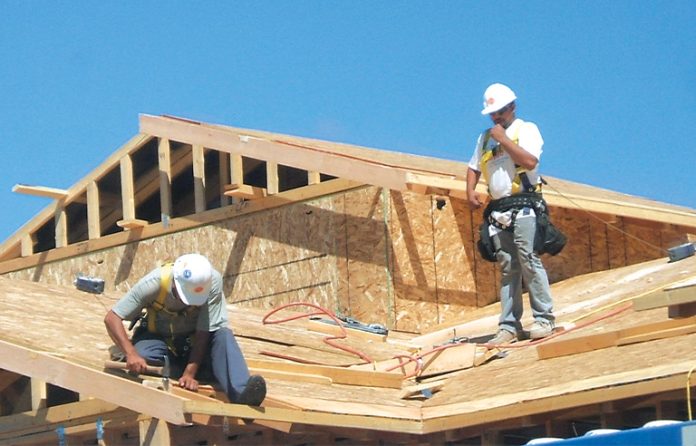
Photo: ACTA Safety
Key points
- An OSHA spokesperson said “challenging conditions” and “pressures to complete jobs quickly” frequently are “compounded by smaller crews, limited training, inconsistent oversight and safety measures that may exist more in theory than practice.”
- Each year, about 37 roofers die as a result of a fall and around 400 are injured, analysis from CPWR – The Center for Construction Research and Training shows.
- Experts recommend refresher training for all employees at regular intervals.
For workers in the roofing industry, multiple hazards combine to create a demanding environment. They include working at height, carrying heavy materials, and exposure to chemicals and bad weather – all amid pressure to complete jobs quickly.
“These challenging conditions are often compounded by smaller crews, limited training, inconsistent oversight and safety measures that may exist more in theory than practice,” an OSHA spokesperson said.
Evidence of “more in theory than practice” is seen in the agency’s annual “Top 10” list of most frequently cited standards. In fiscal year 2025, for example, roofing contractors received the most citations under five of OSHA’s Top 10:
- Fall Protection – General Requirements (1926.501)
- Hazard Communication (1910.1200)
- Ladders (1926.1053)
- Fall Protection – Training Requirements (1926.503)
- Personal Protective and Lifesaving Equipment – Eye and Face Protection (1926.102)
So, what can employers do to ensure safety stays top of mind for roofing workers?
Here’s a closer look at common risks and what the experts recommend for safely navigating them.
Falls: ‘An ever-prevalent risk’
About 37 roofers die each year as a result of a fall, according to CPWR – The Center for Construction Research and Training. Around 400 more are injured.
Multiple industry leaders agree that the dynamic nature of roofing work and the differences between each roof increase the risk for falls.
Subpart (d)(16)(iii) of OSHA’s standard on fall protection systems criteria and practices (1926.502) requires employers to provide personal fall arrest systems to workers exposed to falls of 6 feet or more to a lower level.
As a best practice, some employers opt to use fall protection at lower heights. For example, David Hawn, a registered roofing consultant and president of Centreville, VA-based Dedicated Roof and Hydro-Solutions LLC, recommends fall protection at any elevation change of 4 feet or more.
“What we tell everybody is, ‘Please, remember that OSHA standards are the minimum,’” said Keith Vitkovich, executive director of the Roofers & Waterproofers Research and Education Joint Trust Fund. “An employer, jobsite, contractor, supervisor can always expand the standards.”
CPWR recommends regularly reviewing fall prevention work practices and developing a fall prevention plan before work starts.
“Preplanning in roofing is a major component of what we do,” said Adrianne Anglin, director of safety and risk management at the National Roofing Contractors Association. “A lot of the safety in our work happens before we even start work on the roof.”
Added Hawn: “Really, it’s about having a good plan, having good tools, having proper PPE, recognizing whether you have a hazard or not, and determining whether you can remove that hazard. And if you can’t remove that hazard, then have a meeting and a plan to avoid harm from that hazard.”
Safe access and movement
Training workers on the proper use of fall protection and ensuring sufficient fall protection equipment is accessible are major components of fall prevention – but they’re not the only ones.
“Whether we’re talking a ladder or a scaffold, the way we access the roof needs a lot of focus and can be a hazard if not done correctly,” Anglin said.
In FY 2025, the top section OSHA cited under its standard on ladders was 1926.1053(b)(1), which calls for extending ladder side rails at least 3 feet above the “upper landing surface to which the ladder is used to gain access.”
Under the standard on scaffolding, 1926.451(g)(1) was the section cited most often. It states: “Each employee on a scaffold more than 10 feet above a lower level shall be protected from falling to that lower level.”
Other leading sections cited were related to improper supports and guardrail systems.
Failure to protect activities 6 feet or more above lower levels – whether via guardrails, safety nets or personal fall arrest systems – also was central to the top four sections cited under 1926.501.
Then, once a worker gains access to the roof, it’s vital they know how to move safely while on it.
Guidance from the National Campaign to Prevent Falls in Construction – a collaboration between CPWR, OSHA, NIOSH and the National Occupational Research Agenda Construction Sector Council – includes:
- Choose lighter boots with non-slip, puncture-resistant soles. Specialty “roofer shoes” typically feature non-slip soles, moderate stiffness, rear motion control and more.
- Zig and zag when walking up a sloped surface to reduce incline and control balance.
- When walking across a sloped surface, make sure feet are wide apart and take shorter steps to improve balance.
“I tell all my employers, ‘Never walk backward on a roof,’” Hawn said. “If you can’t see where you’re stepping, don’t step.”
Reinforce training
OSHA says many of its roofing-related citations “highlight moments where shortcuts might lead to severe incidents.”
Added the agency spokesperson: “Staying focused on safety can be tough, especially in fast-moving jobs where pressure is high. That’s why leadership at every level plays a part. The way leaders plan the job, the support they provide and the training they reinforce sends a clear message about what really matters: each team member.”
Subpart (c) of 1926.503 calls for retraining in cases “when the employer has any reason to believe that any affected employee who has already been trained does not have the understanding and skill” required under the standard.
Many industry leaders, however, recommend providing refresher training for all employees at regular intervals, no matter their skill level.
“Because everything changes, and our exposures to hazards change, we have to adapt,” Vitkovich said. “We have to provide different training. As an example, each solvent or chemical we work with could require different types or levels of PPE. Because one type of PPE may not be as effective with this chemical or solvent as it would be with a different one.
“For us, it’s making sure that we make everyone aware of what the hazards are, that we provide quality training to the instructors and we provide quality training resources for them to utilize.”
To Anglin, regular assessments and conversations before work begins are “core” to keeping workers safe.
“I think it’s good to look at things in a similar light as you would in your family situations. ‘Would I let my family do this?’” she said. “In the roofing industry, we have a lot of multigenerational families, and you’ve got a lot of folks that look at it exactly the same way. Because it’s not just an owner sending an employee to do some work on the roof. In many cases, they’re sending family to do work on a roof. So, we’re not just saying it’s like family; in many cases, it is family.”
Weather considerations
Weather- and temperature-related concerns are inherent in roofing work.
“We do not work indoors. We’re in the elements,” Vitkovich said. “We get exposed to basically every element there is for that region.”
The National Campaign to Prevent Falls in Construction offers tips for preparing to work in adverse weather:
- Monitor weather conditions before work and throughout the day.
- Inspect the roof before work starts and as conditions change, checking for icy, wet or slippery conditions.
- Measure wind speeds using a handheld anemometer and consider postponing or halting non-emergency work in high winds. OSHA considers high winds to be those above 30 mph when material handling is involved.
- Develop a plan to provide cover from lightning.
- Plan ahead and implement a heat illness-related prevention program.
Mental health awareness
A recent analysis from CPWR Data Center researchers found that suicides among construction workers ages 16-64 decreased 1.7% between 2023 and 2024.
An accompanying report, which also explored a decline in industry deaths linked to opioid overdoses, suggested that “prevention efforts make a difference.”
CPWR and North America’s Building Trades Union cited multiple factors as possible influences, including decreased stigma around mental health disorders.
Construction occupations maintain “both the highest rate of suicide and the highest number of suicides across all occupational groups,” the Construction Industry Alliance for Suicide Prevention says.
However, experts sense a growth in mental health-related conversations across the industry.
“In the past, you’d go to a funeral and nobody discussed what happened,” Anglin said. “And there’s an awful feeling to that. I would say in the past five to 10 years, that’s shifted in tone and conversation. It’s interesting to see something go from complete and utter silence to a more open communication.”
During an August webinar featuring experts from CPWR and CIASP, several communication strategies were shared:
- “Check in” with yourself before presenting, training or starting a conversation on mental health.
- Be yourself and assess each situation individually. “You know your people better than anyone, so trust your intuition,” said Jessica Bunting, director of CPWR’s Research to Practice initiative and CIASP chair-elect.
- Validate any problems or challenges a worker is facing while providing and maintaining hope.
- Be prepared to assist anyone who’s struggling as they take the first steps to seek professional help or additional peer support.
“A lot of the industry is trying to remove that stigma and put a voice where typically silence has reigned so we can tackle the staggering crisis that this industry faces,” Anglin said.
McCraren Compliance offers comprehensive safety training to help prevent accidents. Visit our class calendar to see how our training and consulting services can enhance your safety efforts.
Original article published by Safety+Health an NSC publication