Controlling hazards boosts safety for utility lineworkers
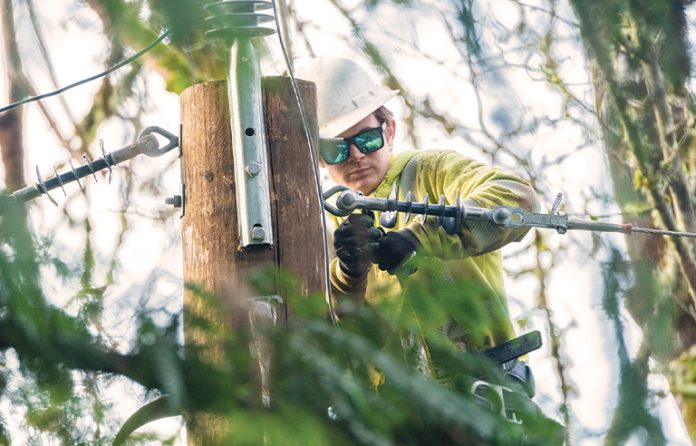
Photos: Puget Sound Energy/flickr
Contact with high-voltage lines, working at height or in confined spaces, being outdoors in inclement weather, the risk of welding and cutting injuries – the list of hazards that electrical utility lineworkers face is long and diverse.
But it’s not insurmountable.
“Accidents can be prevented,” Mike Boyd said, “if the right mitigations are done and you’re following the right steps.”
Boyd is executive director of the Madisonville, LA-based Fallen Linemen Organization, which helps raise money to support families of lineworkers who’ve died or been severely injured on the job. FLO estimates that 45 lineworkers suffer fatal occupational injuries each year.
To Curtis Bradley, corporate safety program manager at Asplundh Construction – whose services include utility construction and maintenance – lowering that figure begins with heightened worker recognition of hazards and surroundings.
“It’s about maintaining situational awareness – making sure you’re mentally and physically where you need to be in the moment so the job can be done safely,” Bradley said.
‘Get everybody involved’ in identifying hazards
A lineworker’s job tasks can expose them to several fall hazards, from climbing poles and towers to working from bucket trucks or elevated platforms.
Ergonomics issues are a concern, too, Bradley says. Many duties include heavy lifting, repetitive motion and awkward positioning. In addition, vehicles and equipment regularly are on the move below lineworkers at height.
Despite the dynamic nature of the work, incidents in the industry often occur during routine tasks.
“We’re always fighting complacency,” Bradley said. “When we get too comfortable, we let our guard down – and that’s when incidents occur.”
Adds Boyd: “You may have done it 100 times, and then that 101st time, it gets you.”
Boyd and Bradley emphasized that employers and workers need to take their time when conducting a job hazard analysis before work begins.
If the goal is to identify hazardous work conditions, it’s only logical.
“It’s a profession that has a lot of hazards that you have to mitigate,” Boyd said. “You’re supposed to start your day with your crew going over those mitigations, going over the hazards and what we’re going to do to prevent the hazards.
“You discuss it and get everyone involved in it so that if one person takes that shortcut, somebody opens their mouth and says, ‘Wait, whoa, we skipped a step!’”
Prepare for electrical hazards
Even with standards in place, electrical exposure “remains one of the most significant dangers” to lineworkers, Bradley said.
Electricity-related situations these workers need to prepare for include:
- Contact with energized conductors
- Unanticipated back feed, or reversal of electric flow
- Induction – the process through which a conductor becomes electrified near a charged body
- Failures in grounding and deenergization procedures
OSHA’s standard on electric power generation, transmission and distribution (1910.269) requires workers to be “trained in, and familiar with, the safety-related work practices, safety procedures and other safety requirements” related to their job assignments.
Under 1910.269(d)(2)(i), employers must have a program comprising energy control procedures, worker training and periodic inspections to “ensure that, before any employee performs any servicing or maintenance on a machine or equipment where the unexpected energizing, start up, or release of stored energy could occur and cause injury, the machine or equipment is isolated from the energy source and rendered inoperative.”
Subpart (d)(6)(viii) of the standard states that “if normally energized parts will be exposed to contact by an employee while the machine or equipment is deenergized, a test shall be performed to ensure that these parts are deenergized.”
Additionally, Bradley recommends employers and workers follow the National Fire Protection Association’s voluntary standard for electrical safety in the workplace – NFPA 70E – and various Institute of Electrical and Electronics Engineers voluntary standards.
Make sure to clearly communicate standards and requirements in a way workers can easily understand and verify their understanding through a structured knowledge check or teach-back.
Communicate when climbing
Safety is paramount when it comes to working at height or operating in adverse weather conditions.
The Southern California Chapter of Associated Builders and Contractors offers these tower climbing safety tips:
- Secure yourself to the tower with a safety harness and lanyard before climbing.
- Use proper personal protective equipment.
- Prioritize precision over speed – maintain good form and conserve energy while climbing to reduce fatigue and minimize errors.
- Inspect climbing gear regularly for wear, corrosion or damage.
- Assess wind speed, visibility and temperature before beginning a climb.
- Descend immediately if adverse weather conditions approach.
Effective communication is equally important, experts say. On the job, two-way radios or hand signals can help ensure crew members understand their work responsibilities and allow for instant feedback if something seems amiss.
With that, industry leaders call on supervisors to make sure workers realize their ability to exercise stop-work authority and halt a job or task until hazards are abated.
“Having a questioning attitude and using stop-work authority can prevent a range of safety failures,” Bradley said. “Asking that extra question when something isn’t clear – or speaking up when something doesn’t look right – allows hazards to be resolved before they turn into incidents.”
In addition to completing a JHA to identify potential hazards before work begins, Boyd recommends that crews meet for a post-shift briefing.
Ask whether crew members encountered anything they didn’t catch initially and discuss how work might improve next time.
“It’s a constant review of what you’re doing, what went well, what you could have done better,” Boyd said.
A growing need
Sound electrical infrastructure is crucial for powering communities and businesses, and utility line work goes with the territory.
Still, the ongoing artificial intelligence boom is expected to create projects – and jobs – for lineworkers amid additional energy needs.
An April 2025 report from the International Energy Agency states that electricity demand for data centers worldwide is set to more than double by 2030. The United States accounted for 45% of global data center energy consumption in 2024, IEA adds.
No matter the nature or location of a project, crews can help control hazards through a combination of engineering controls and administrative controls, training, and PPE.
One administrative practice, establishing a work zone traffic control plan, is especially important because industry incidents stemming from distracted driving have grown, in Boyd’s experience.
NATE: The Communications Infrastructure Contractors Association has suggestions:
- Equip workers with high-visibility vests, proper head and eye protection, and steel-toe footwear.
- Check whether the jurisdiction where the work is being performed has requirements for written traffic control plans. Make sure signs or temporary traffic control devices are visible to drivers.
- Use a flagger or spotter if the work zone encroaches on a lane of traffic.
- Direct traffic safely around the work zone while also accounting for pedestrians. Use cones to mark off the area and caution tape to direct people away from open trenches or holes.
Referencing the entire industry, Boyd said: “It’s just a lot of different situations. If you don’t have the experience, you’ve got to open your mouth. You can’t sit there. It just doesn’t work.”
Bradley reiterates that communication is critical to safe line work, beginning with messaging from leadership.
“You have to make sure everyone is committed to the goal of going home safely,” he said. “A strong safety culture begins when leadership sets the tone and consistently demonstrates that safety is the top priority.
“Everything else builds from that foundation.”
McCraren Compliance offers comprehensive safety training to help prevent accidents. Visit our class calendar to see how our training and consulting services can enhance your safety efforts.
Original article published by Safety+Health an NSC publication