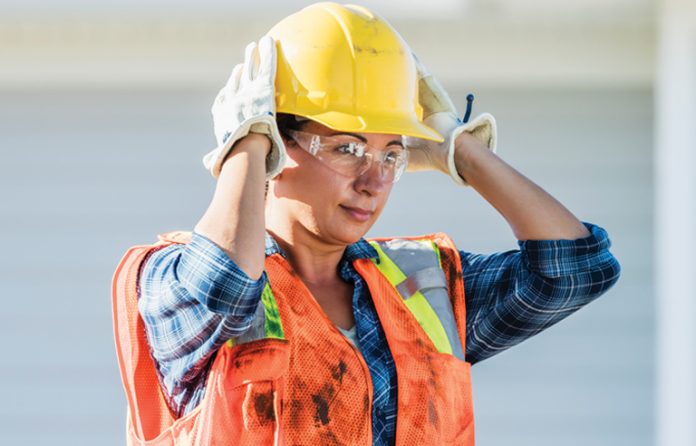
Proper head protection is a must whenever work environments have the potential for falling objects; struck-by or overhead electrical hazards; and risks from slips, trips and falls.
In these situations, both employers and workers can take steps to make sure proper head protection is a routine part of the job. We asked David Consider, senior safety consultant at the National Safety Council, and Jessica Bunting, director of research to practice at CPWR – The Center for Construction Research and Training, for advice. With their help, we’ve put together four questions safety pros should ask themselves about head protection.
Is the right type being used?
Consider said he’s observed workers wearing a bump cap when a hard hat or a safety helmet was needed.
A bump cap is designed to protect a worker’s head from a minor impact. A hard hat or safety helmet provides protection against more substantial blows.
Another example is using Type I head protection to guard against a side impact. Type I head protection is designed specifically for potential strikes to the top of the head, OSHA says.
Type II protection, meanwhile, guards against impacts to other parts of the head in addition to the top.
Wearing Class C (conductive) head protection when electrical hazards are present is another example of incorrect head protection use in the workplace. Class E (electrical) head protection shields a worker against up to 20,000 volts (phase to ground), while Class G (general) provides electrical protection typically up to 2,200 volts.
Have I conducted a hazard assessment?
Safety pros can determine what kind of head protection is appropriate by performing a hazard assessment, which is required by OSHA.
The term is included in the agency’s general industry standard on personal protective equipment (1910.132). In its construction standards (specifically 1926.28), OSHA states that employers are “responsible for requiring the wearing of appropriate personal protective equipment in all operations where there is an exposure to hazardous conditions.”
To understand those “hazardous conditions” and determine the appropriate PPE needed, employers need to perform an assessment.
In addition to protecting against falling objects or electrical shock, Consider said other risks include chemical exposures; hot work; high and low temperatures; and “whether integrated faceshields, hearing protection, communication devices and miner lights may be required.”
Is it being worn correctly?
Under a final rule that went into effect in January 2025, OSHA requires all PPE worn by construction workers to fit properly. (The requirement was already part of the agency’s general industry standards.) The agency called poorly fitting PPE “a long-standing industry safety concern, particularly among some women as well as among physically smaller or larger workers.” (Go to bit.ly/3VUF8wJ to learn more.)
Consider said asking these questions can help gauge if head protection fits properly:
- Is the head protection centered on the head?
- Is the headband resting comfortably on the worker’s forehead?
- Does the chin strap have a “snug” fit?
- Is there about 1 inch of clearance between the head and the hard hat shell?
Another issue: Workers often don’t have the suspension on their head protection properly adjusted. The suspension system is important “because it allows for a secure fit and creates a gap between the shell and the head,” Bunting said. “This design helps the hard hat absorb forces from an impact such as a fall, reducing what’s transferred to a worker’s head.”
Regarding the 1 inch of clearance, it’s not uncommon to see workers wearing a hoodie, cap or other items under their head protection. These items can interfere with that clearance between the shell and the head, Bunting said.
Products designed to be worn under head protection (winter liners and sunshades, for instance) are available. However, Bunting recommends consulting with the head protection manufacturer or the ANSI/ISEA standard before use.
Some workers may wear their head protection backward when it’s not designed to be worn that way. To find out, check out the head protection itself. The models that are designed (and certified) to be worn backward are marked with a “reverse donning symbol, which is two arrows curving to form a circle,” Consider said.
Is it being regularly inspected (and replaced after incidents)?
How often should head protection be inspected? At a minimum, before each workday. Workers should check for cracks, dents and other damage. OSHA recommends running your fingers over the surface to make sure no “irregularities” exist.
For head protection that has a chin strap, examine it for cuts, tears, fraying or any other issues, Bunting said.
If an impact occurs, head protection should be replaced immediately – even if damage isn’t evident.
“Impact can weaken the material or cause suspension issues, which may not be immediately noticeable but can affect the headgear’s ability to protect you in the future,” Bunting said.
McCraren Compliance offers many opportunities in safety training to help circumvent accidents. Please take a moment to visit our calendar of classes to see what we can do to help your safety measures from training to consulting.
Original article published by Safety+Health an NSC publication