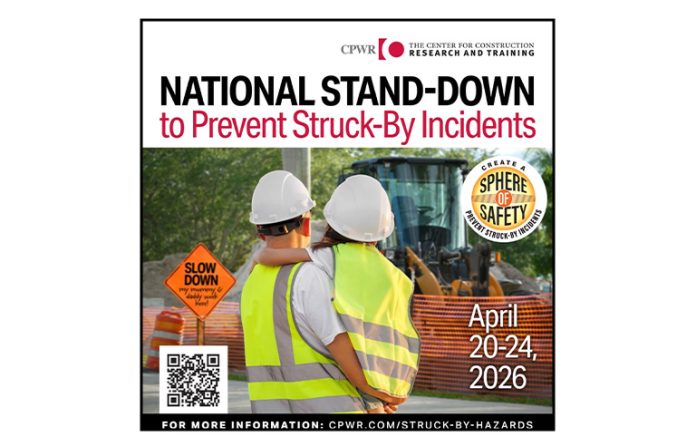
Photo: CPWR – The Center for Construction Research and Training
Silver Spring, MD — Every activity counts during the National Stand-Down to Prevent Struck-by Incidents, set to take place April 20-24.
“It doesn’t matter exactly how long it is or what you talk about,” said Brad Sant, senior vice president of safety and education at the American Road & Transportation Builders Association. “It’s just that you do it.
“You get good information, good resources that are developed by the industry for the industry, and you talk about it. You help make the workers aware. You empower them to take action when they see hazards and incentivize them to report what they see.”
Sant spoke during a March 25 webinar hosted by CPWR – The Center for Construction Research and Training. The event featured input from multiple organizations, including OSHA, and highlighted resources that employers can use to talk with workers about struck-by hazard recognition and prevention.
On its website, CPWR has more than 50 resources related to the stand-down, now in its seventh year and taking place in conjunction with National Work Zone Awareness Week. Many are available in Spanish.
Jessica Bunting, director of research to practice at CPWR, told webinar attendees that leaders who are active and present on the jobsite can help messaging resonate long after the stand-down has concluded.
“The best way to enforce or reinforce anything is by leadership involvement,” Bunting said. “Leading by example. Making sure that the workers know what is going on, that you are implementing engineering controls and training and tackling it from all different angles.”
McCraren Compliance offers comprehensive safety training to help prevent accidents. Visit our class calendar to see how our training and consulting services can enhance your safety efforts.
Original article published by Safety+Health an NSC publication