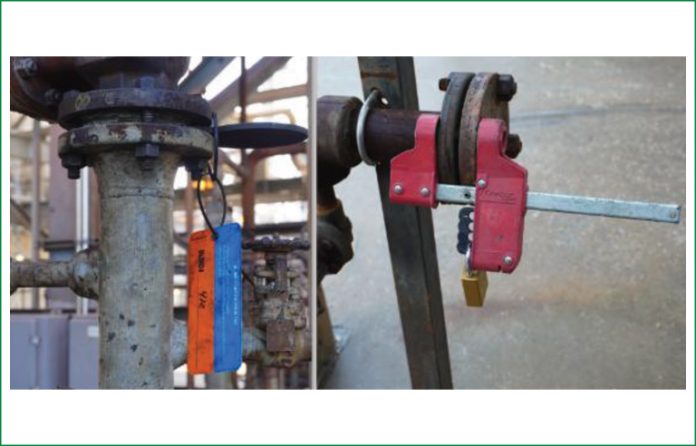
Blind tag (left) and flange-locking device (right). Photo: Chemical Safety Board
Washington — Using pipe markings and detailed drawings can help chemical facility workers ensure “all parties understand which equipment should be opened” before beginning work, the Chemical Safety Board says in a recent report.
The final report covers the investigation of an October 2024 incident at the PEMEX Deer Park (TX) Refinery.
Two workers died and 13 were injured after the release of about 27,000 pounds of hydrogen sulfide – a toxic, colorless gas that OSHA says is “one of the leading causes of workplace gas inhalation deaths in the United States.” The release occurred after contract workers opened an incorrect flange – a result, in part, of insufficient maintenance and training protocol, CSB concluded in its investigation.
The agency found that the contract workers were supposed to open a different flange on piping about 5 feet away that had been depressurized, purged and isolated.
“Opening hazardous process piping is a common maintenance activity that can be performed safely with effective equipment identification and work permitting practices,” Tyler Nelson, CSB investigator in charge, said in a press release.
“This tragic incident underscores the critical importance of equipment identification methods that are clear, consistent and verified by both facility operators and contract workers before equipment is opened.”
CSB recommends that the American Society of Mechanical Engineers develop written guidelines for marking equipment for opening, applying the markings and removing them once work concludes.
The board also offers lessons to help prevent similar incidents:
- Use standardized markings with verification requirements when identifying equipment to be worked on.
- Make sure the scope of the work permit is appropriate for the job and includes controls for all specific hazards.
- “Hold points” within a permit-to-work system help ensure critical actions aren’t missed or skipped before work continues. Check that hold points are unambiguous and clearly define responsibilities.
- Establish direct communication between company personnel and workers performing a job to ensure the most accurate handoff of information.
- Ensure written programs represent actual organizational practices.
McCraren Compliance offers many opportunities in safety training to help circumvent accidents. Please take a moment to visit our calendar of classes to see what we can do to help your safety measures from training to consulting.
Original article published by Safety+Health an NSC publication