


Washington — OSHA has released interim enforcement guidance on certain handrail and stair rail system requirements.
According to a memo issued Feb. 26, the guidance is expected to remain in place until the agency finalizes a proposed rule issued in 2021.
The impetus for the proposed rule was a formatting error in Table D-2 of the 2016 Walking-Working Surfaces final rule. OSHA inadvertently omitted several words for “a stairway with a width of less than 44 inches and two open sides.”
The table currently states that the agency requires “one stair rail system each open side,” but OSHA intended to require “one stair rail system with handrail on each open side.”
The interim enforcement guidance notes that “OSHA also recognized that employers may have relied on the error in Table D-2 when installing stair rail systems less than 44 inches wide.”
The agency says that citations under 1910.28(b)(11)(ii) or 1910.29(f)(1)(iii) won’t be issued if stair rail and/or handrail systems are installed before the effective date of a new final rule and comply with the 2021 proposed rule.
Additionally, OSHA says:
- Flights of stairs less than 44 inches wide with two open sides must have a stair rail system on each open side but aren’t required to have a separate handrail.
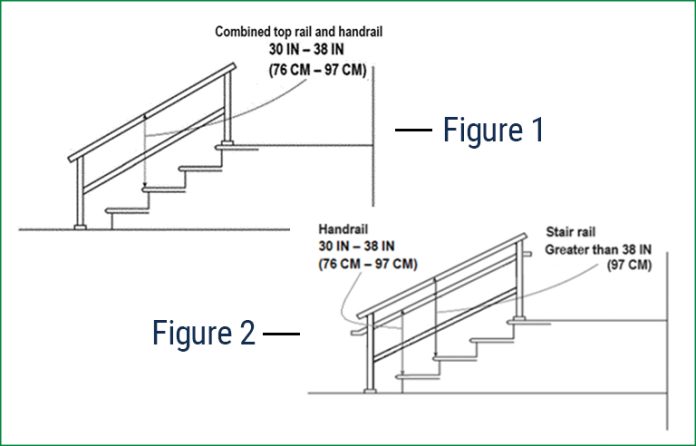
- The height of a stair rail system must be no less than 30 inches, as measured from the leading edge of the stair tread to the top surface of the top rail. Where the top rail of a stair rail system isn’t less than 30 inches and not more than 38 inches, it can also serve as a handrail, provided it meets the other handrail requirements of 1910.29(f).
- When the top rail of a stair rail system exceeds 38 inches in height [e.g., to meet the 42-inch minimum height requirement in current (2016 final rule) 1910.29(f)(1)(ii)(B)] and a handrail is required by current (2016 final rule) Table D-2 in 1910.28(b)(11)(ii), the handrail must be separate from the top rail and no less than 30 inches and no more than 38 inches in height, as measured from the stair tread leading edge to the top surface of the handrail.
The interim guidance includes two illustrative drawings (Figures 1 and 2).
McCraren Compliance offers many opportunities in safety training to help circumvent accidents. Please take a moment to visit our calendar of classes to see what we can do to help your safety measures from training to consulting.
Original article published by Safety+Health an NSC publication