
FACE photos: NIOSH
Case report #: 71-274-2026
Date of report: March 6, 2026
Issued by: Washington State Fatality Assessment and Control Evaluation Program
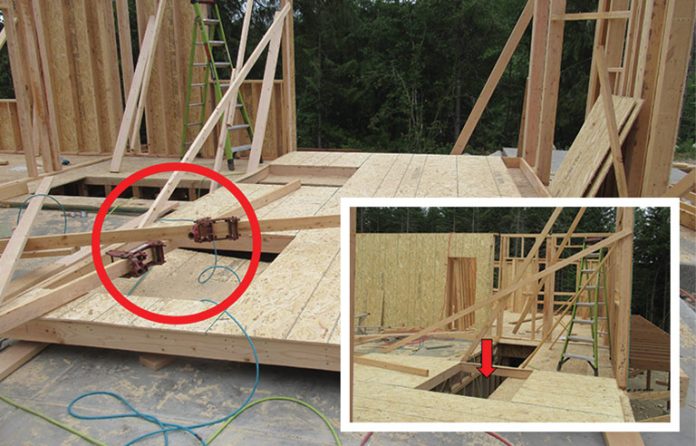
A 73-year-old framer had worked for his employer, a residential framing contractor, for eight years. On the day of the incident, he was part of an experienced six-worker crew raising an external wood-framed wall that was around 14 feet high and weighed 2,100 pounds. The workers were raising the wall from a concrete slab floor over a basement using two portable iron wall jacks installed on two 12-foot-high two-by-four lumber posts. The jacks were under the wall’s top plate, and the posts were standing straight up and unsecured on the floor. The plan was to manually ratchet the jacks up the posts to lift the wall into place. After the crew began to lift, members attached a pair of two-by-four lumber push sticks to a window cutout in the upper part of the wall. The framer was pushing the stick on the right side of the cutout. When the wall reached a 70-degree tilt angle, the crew attached wood braces to the posts to support the jacks higher up. The crew then finished raising the wall into its fully vertical position. Once the wall was up, the wall jack posts were freestanding. Before the wall could be secured, a brace on the right side gave way. The wall collapsed and struck the framer in the back of his head. The impact caused him to fall through an unguarded floor opening beside him. He fell 8 feet to the concrete floor below. His co-workers called 911 and performed CPR until first responders arrived. The worker was pronounced dead at the scene. Investigators found that the floor opening had been covered by the wall before it was raised. The crew members stated that they did not have enough lumber to cover the opening as they usually did. The employer did not ensure workers used a guardrail, cover or other fall protection system to prevent falling through the opening.
To prevent similar occurrences, employers should:
- Develop policies that require workers to manually support and secure walls after raising, and install and secure covers before working around openings.
- Create a restricted access zone. Its length and width should equal the wall plus 4 feet on both sides of it. Mark the zone and continuously monitor it to prevent access while the wall is being raised and secured.
McCraren Compliance offers comprehensive safety training to help prevent accidents. Visit our class calendar to see how our training and consulting services can enhance your safety efforts.
Original article published by Safety+Health an NSC publication