
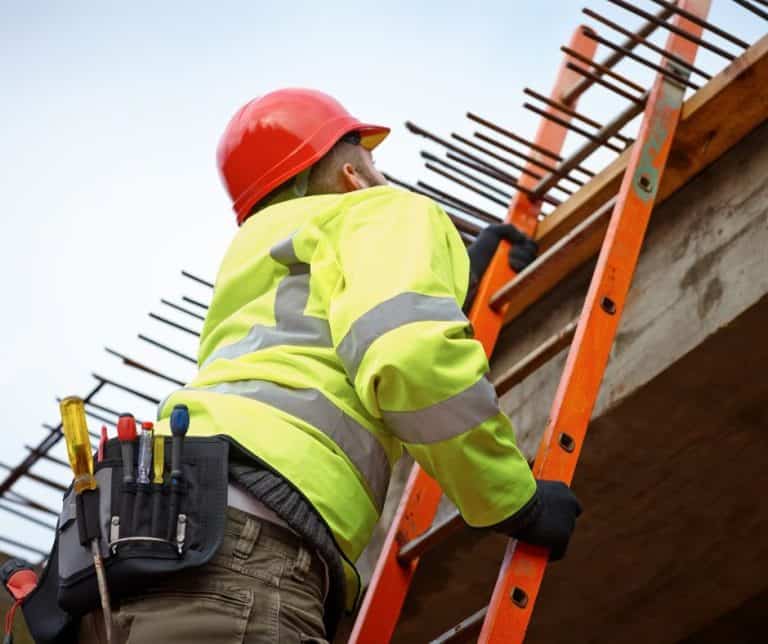
Ladder violations consistently rank among OSHA’s most cited workplace safety issues (in 2025, it ranked third in the agency’s top 10 list of most frequent citations). That’s why ladder safety is so important.
If you’re an employer, knowing the warning signs early can prevent injuries, citations, and lost productivity.
What’s OSHA’s Definition of Ladder Safety?
OSHA regulates ladder safety under two primary standards:
- 29 CFR 1926 Subpart X for construction
- 29 CFR 1910.23 for general industry
Under these standards, employers must ensure ladders are:
- Used only for their designed purpose
- Inspected before use
- Free from structural defects
- Used on stable, level surfaces
- Set up at proper angles
- Secured when necessary
For example, extension ladders must follow the 4 to 1 rule. For every 4 feet of height, the base must be 1 foot away from the wall. Workers must also maintain three points of contact while climbing.
What You Stand to Lose When Ladder Safety Violations Happen
Falls from ladders can cause fractures, head injuries, spinal damage, and fatalities. According to the Bureau of Labor Statistics, falls remain one of the leading causes of workplace deaths in the United States.
For employers, the cost adds up quickly:
- OSHA citations and fines
- Workers’ compensation claims
- Project delays
- Increased insurance premiums
- Damaged reputation
8 Signs You’re at Risk of a Ladder Safety Violation
If you see these behaviors on your jobsite, you’re likely at risk.
- Ladders are not inspected before use. OSHA requires ladders to be inspected for visible defects before each work shift. If your team grabs a ladder without checking for cracked rails, loose rungs, or missing feet, you’re exposed.
- Workers stand on the top step or top cap of a step ladder. This is one of the most common violations. The top step is not designed for standing. If you see people doing this to “gain just a little more height,” you have a training gap.
- The ladder is the wrong type for the job. Using a step ladder like an extension ladder. Using a metal ladder near electrical work. Using a ladder that does not meet the height requirement. If the ladder feels like a compromise, it probably is.
- Improper ladder angle. Extension ladders placed too steep or too shallow increase fall risk. If no one measures or visually checks the 4 to 1 ratio, stability is not guaranteed.
- Overreaching. If workers lean their belt buckle beyond the side rails, the center of gravity shifts. OSHA identifies overreaching as a leading cause of ladder falls. When you see someone stretching instead of climbing down and repositioning, that’s a violation waiting to happen.
- Unstable surfaces. Ladders set on boxes, uneven ground, slippery floors, or unsecured platforms signal trouble. OSHA requires ladders to be used only on stable and level surfaces unless secured.
- Carrying tools while climbing. Three points of contact must be maintained at all times. If workers carry tools in their hands instead of using tool belts or hoists, they sacrifice stability.
- Lack of training. Under OSHA standards, employers must train workers to recognize ladder hazards. If employees cannot explain proper setup, inspection steps, or load ratings, your organization is vulnerable.
OSHA’s full guide to stairways and ladders outlines the requirements in detail. You can download it directly from OSHA here.
Arizona Chapter National Safety Council remains committed to helping employers and workers eliminate preventable injuries. Staying informed and recognizing risk before it turns into harm is one of the simplest ways to keep each other safe.
McCraren Compliance offers many opportunities in safety training to help circumvent accidents. Please take a moment to visit our calendar of classes to see what we can do to help your safety measures from training to consulting.
Original article published by Arizona Chapter National Safety Council